The role of neutrophil response in lung damage and post-tuberculosis lung disease: a translational narrative review

Invalid Access Key! Invalid Access Key!
“Plague of green fruit bugs | Valley Life | avpress.com - Antelope Valley Press” plus 2 more |
| Plague of green fruit bugs | Valley Life | avpress.com - Antelope Valley Press Posted: 13 Jul 2019 04:00 AM PDT  Normally around this time of year we start seeing large metallic green bugs that fly erratically. The large metallic green beetles are called green fruit bugs or some call green june bugs. The green fruit bug starts as eggs laid in the soil usually with high organic content. In the Antelope Valley, the beetle likes to lay its eggs in horse manure or around stables. Around your homes compost piles are very popular. The larvae are large white grubs, and it is the most common grub that we find when digging in the garden. The larva often emerges out of the ground after a prolonged rain or irrigation in spring. After the rain, they will dig themselves back into the compost. The larva lives all summer devouring any organic matter and any roots in its path. Green fruit bugs fly erratically in search of food, which includes hollyhocks, ripening fruit, the foliage and fruit of many trees and shrubs. Here in the Antelope Valley they are particularly fond of ripe peaches. The larva of the green fruit bug is also a pest. In fact, the larva is usually a bigger pest than the adult, and eats roots of grasses, alfalfa, vegetables, and ornamental plants. Luckily, it prefers decaying organic matter that is commonly found in compost piles, if you find large white grubs in the soil, especially your compost pile, it is the larva of the green fruit bug. Killing the grubs, not the adults, is the best way to control green fruit bugs. Fumigating the soil or drenching the soil with a pesticide is the most common. Rototilling the soil (if possible) can help, however it has limited results because the grubs may be too deep for the rototiller. Turning your compost pile frequently in the spring can control the grubs in the compost pile. A backyard control method that has had some success is to trap the adult beetles. A mixture of equal parts of grape juice and water or equal parts of peach juice and water has been reported as an attractant for green fruit bugs. Place an inch of solution in the bottom of a one-gallon milk container. Make a funnel of a small mesh wire and insert the funnel in the jar. The beetles are attracted to the jar and crawl down the funnel into the jar. The beetles cannot climb back out of the jar. The green fruit bugs and their grubs look worse than the damage they normally cause.  |
| A plague in the valley | Weekend Magazine - Rutland Herald Posted: 12 Jul 2019 09:00 PM PDT  In 1760, a relentless phalanx of army worms devoured almost every green thing in its path on its march through the Connecticut River Valley. The crawling river of caterpillars wreaked havoc on crops from Vermont's Northeast Kingdom to Northfield, Massachusetts. Eerily reminiscent of a plague from the bible, the Upper Valley settlers would have starved had not wild pigeons mysteriously appeared to offer them sustenance through the subsequent months of 1760. The crawling creatures made a gradual appearance in late July and grew in numbers and strength into September. The Vermont Journal, a newspaper from Windsor, reported, "they marched with great speed and ate up everything green for the space of 100 miles in spite of rivers, ditches, fires, and the united efforts of 1,000 men." Some residents of the Valley called them "The Northern Army," as they marched southward in an endless formation. A detailed account was published in Grant Powers' "History of Coos County" (1841). "Dr. Burton, of Thetford, Vermont, told me that he had seen whole pastures so covered that he could not put down his finger in a single spot, without placing it upon a worm. He said, he had seen more than 10 bushels in a heap. They were unlike anything which the present generation have ever seen. There was a stripe upon the back like black velvet; on either side, a yellow stripe from end to end; and the rest of the body was brown." When mature, they were the size of a man's finger and moved with great speed, stopping only to devour food — often crops planted by the settlers in the Vermont and New Hampshire towns they passed through. The worms were actually moth larvae or caterpillars, and occasional outbreaks of army worms are still reported in Vermont. While they continue to be capable of destroying crops, modern pest control methods have been able to efficiently curtail their destruction. Powers' history records their predations: "They filled the houses of the inhabitants, and entered their kneading-troughs, as did the frogs in Egypt. They would go up the side of a house, and over it, in such a compact column, that nothing of boards or shingles could be seen They did not take hold of the pumpkin-vine, peas, potatoes, or flax; but wheat and corn disappeared before as by magic. They would climb up the stalks of wheat, eat off the stalk just below the head, and almost as soon as the head had fallen upon the ground, it was devoured." One way to combat the menace was to "draw the rope." Two men, one at each end of a rope pulled taught between them, would walk through a wheat field, the rope dislodging the caterpillars and temporarily knocking them from the stalks. The farmers soon learned that the action offered only temporary relief from the onslaught. Corn fields were reduced to bare stems in a matter of days. In desperation the settlers dug trenches one and a half feet deep around their fields, but the interminable column filled the ditches with their bodies, and those in the following ranks soon made passage on the backs of their predecessors. The farmers waged a constant vigil and were able, by their tenacity, to save at least seed corn for the following planting season. Finally, by September, the infestation began to wane. It is likely that the caterpillars had begun their metamorphosis into the moths that were their destiny. Powers noted: "This visitation, which destroyed the principal grains of that year, was felt severely by all the new settlements; for it not only cut off their bread-stuffs, but it deprived them of the means of making their pork to a great degree, and reduced the quantity of fodder for their cattle. Jonathan Tyler, of Piermont, related to me, that the settlements in that town were left without the means of subsistence from their own farms. His father drew hay on a hand-sled upon the ice, from the great Ox Bow in Newbury, to support his cow the following winter. And had it not been for two sources opened for their support, they must have deserted the town." The first source was the pumpkins that, by custom, had been sown between the corn rows. After the worms destroyed the corn, the pumpkins grew with a renewed vigor, due to the absence of competition for soil nutrients, and the harvest was so great that the farmers of Newbury gave pumpkins to neighboring towns in such numbers that their neighbors had to build rafts to carry them home on the river. The second source was the immense flocks of passenger pigeons that still migrated through the northeast. Samuel Peters' 1781 "History of Connecticut" acknowledges this event. "The inhabitants of Vermont would unavoidably have perished by famine in consequence of the devastation of these worms, had not a remarkable Providence filled the wilderness with wild pigeons which were killed by sticks as they sat on the branches of trees in such multitudes that 30,000 people lived on them for three weeks." The roosting birds were often clubbed to death, and their trees felled to take the unfledged squabs from their nests. Still plentiful in 1760, the pigeons provided sustenance for the farmers of the Upper Valley. The Tylers of Piermont reportedly took 400 dozen in a matter of days. "They carried them to Piermont, and made what is defined, in the Yankee vocabulary, "a bee," for picking pigeons; and two or three times a week the people of Haverhill were invited down to Mr. Tyler's to pick pigeons. Those who went had the meat of all they picked, and the Tylers had the feathers; and they made, says Jonathan Tyler, "four very decent beds of those feathers." The bodies of those pigeons, when dressed, dried, and preserved for the winter, were very palatable and nutritious, and proved a good substitute for other meats, of which the inhabitants had been despoiled by the Huns and Goths of the north." Once so plentiful that they blackened the sky from one horizon to the other, the wanton slaughter drove the passenger pigeon to extinction. The last bird died in captivity in 1914. In the Upper Valley, the following spring, the famine was followed by flood, but nevertheless, the settlers persisted, despite many having their land buried under two to three feet of silt which made the acerage unusable for two or three years. The account in Hemenway's Gazetteer concludes, "This calamity, so soon succeeding that of the worms, was regarded by many a controversy of the Lord with his family." Not surprisingly, the tenacious spirit of the settlers in the Upper Valley was unbroken by famine and natural disaster, and their progeny continue to prevail on the great river. While army worms have continued to threaten crops in other parts of the country, there were no subsequent outbreaks of such proportions reported in northern New England. Paul Heller is a historian and writer who lives in Barre. His writings are featured regularly in The Times Argus.  |
| Chester 17th Century plague carving goes up for auction - BBC News Posted: 08 Jul 2019 07:09 AM PDT 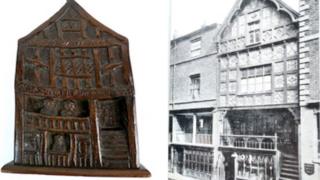 Image copyright Halls fine Art Image copyright Halls fine Art A 17th Century wooden carving which gave thanks to God for allowing a family to survive the plague has gone up for auction after sitting on a mantelpiece for more than 100 years. The 1652 piece was created in tribute to a house in Chester, whose residents fortuitously survived a plague that decimated the city. Its current owner had no idea of its history when she had it valued. Auctioneer Joseph Trinder described the piece as a "one-off". The oak carving depicts the house at 9, Watergate Street and is inscribed with the words "God's providence is mine inheritance". The home became known as God's Providence House after its inhabitants avoided the disease that killed everybody else in the street. Some 40% of Chester's 5,000 population was wiped out by the plague of 1647-1648. The original building was destroyed and the current house built in 1652, when the carving is thought to have been created. The house was restored again in 1862 and now partly houses a coffee shop. The carving's owner Juliet Blackie inherited it from her grandfather Robert Beswick, who was born in 1884 and was known to be an avid collector of historical artefacts. Ms Blackie kept it above the fireplace of the family home, where it is thought to have remained for at least the past 100 years. It is expected to raise between £800 and £1,200, although Mr Trinder admitted it was "one of a kind and difficult to value". The auctioneer, of Halls Fine Art in Shrewsbury, said: "I was aware of the story and of the house of which this carving is an illustration, but I could not be sure if there was a direct link until I saw the date 1652 carved into the panel. "That is the precise date when the house was rebuilt. Then I was sure that this dedication panel and its thanks to divine providence was the real thing."  |
| You are subscribed to email updates from "plague" - Google News. To stop receiving these emails, you may unsubscribe now. | Email delivery powered by Google |
| Google, 1600 Amphitheatre Parkway, Mountain View, CA 94043, United States | |


Comments
Post a Comment