Tuberculosis Clinical Care for Children

Invalid Access Key! Invalid Access Key!
“NMDOH: Cat diagnosed with plague in Los Alamos County - KRQE News 13” plus 1 more |
| NMDOH: Cat diagnosed with plague in Los Alamos County - KRQE News 13 Posted: 11 Feb 2021 12:00 AM PST  NEW MEXICO (KRQE) – A cat in Los Alamos County has been diagnosed with the plague, making it the first plague case in the state this year. The New Mexico Department of Health says the cat became ill in early January. The bacterial disease is typically transmitted through insect bites or by eating infected animals. It can also be transmitted to people. NMDOH reports the cat has now recovered following treatment. "NMDOH staff will conduct an environmental investigation to ensure the safety of the immediate family and neighbors," said Secretary-Designate Dr. Tracie Collins in a news release. "We also offer a friendly reminder: even in the midst of a global pandemic, other diseases still occur in New Mexico, and there are steps people can take to keep themselves and their pets safe." According to a news release, symptoms of plague in humans include sudden onset of fever, chills, headache, and weakness. NMDOH says in most cases there is swelling of the lymph node in the groin, armpit, or neck area. NMDOH says plague symptoms in cats and dogs are fever, lethargy, and loss of appetite; there may be swelling in the lymph nodes under the jaw. NMDOH also says with quick response and diagnosis and appropriate antibiotic treatment, the probability of death in people and pets can be greatly reduced. NMDOH says doctors or veterinarians who suspect plague should promptly report to NMDOH by calling 505-827-0006. NMDOH offers some tips to prevent plague:
 |
| California has its first case of plague in 5 years. How likely are you to catch it? - CBS News Posted: 20 Aug 2020 12:00 AM PDT In the Middle Ages, the plague caused tens of millions of deaths in Europe in a series of outbreaks known as the Black Death. And while it's extremely rare in modern times, the deadly bacterial infection is still around today — but how likely are you to catch it? This week, California reported its first case of plague in five years. The patient, a resident of the South Lake Tahoe area, is said to be recovering at home. And in July, a 15-year-old boy in western Mongolia died of bubonic plague that he contracted from an infected marmot. According to the World Health Organization (WHO), a total of 3,248 cases were reported worldwide between 2010 and 2015, resulting in 584 deaths. The Democratic Republic of the Congo, Madagascar and Peru were the most affected countries. Reports of the plague can be scary — but experts say there's little cause for concern in most cases. What is the plague?Plague is a disease caused by the bacterium Yersinia pestis, which affects humans and other mammals. There are three types of plague: bubonic, septicemic and pneumonic. Bubonic is the most common form, accounting for more than 80% of cases in the U.S. Pneumonic plague is the most serious. Many animals can get the plague, including rock squirrels, wood rats, ground squirrels, prairie dogs, chipmunks, mice, voles, and rabbits. It's typically transmitted from animals to humans, with much more rare cases of the disease being spread person to person. How is the plague transmitted?The plague is transmitted through fleas that live on rodents, according to the U.S. Centers for Disease Control and Prevention (CDC). People typically get bubonic or septicemic plague after they are bitten by a flea that is carrying the bacterium. Humans may also contract the disease when handling an animal that is infected, resulting in either bubonic or septicemic plague. In some cases, people can catch the pneumonic plague when an infected person coughs, causing infectious droplets to spread. This is the only way for the plague to spread between people. Cats and dogs can both lead to human infections. Cats are particularly susceptible to getting sick, and have been linked to several cases of human plague in the U.S. via respiratory droplets in recent decades. What are the symptoms of the plague?A key symptom of the bubonic plague is buboes: painful, swollen lymph nodes in the groin or armpits. Other symptoms include fever, weakness, coughing and chills. Patients with septicemic plague develop fever, chills, extreme weakness, adnominal pain, shock and possibly internal bleeding. Skin and other tissues, especially on fingers, toes, and the nose may turn black and die. Patients with pneumonic plague — the most serious form of the disease — develop fever, headache, weakness, pneumonia, shortness of breath, chest pain, cough and sometimes bloody or watery mucous. Pneumonia could cause respiratory failure and shock. What regions are most affected by the plague?The plague was first introduced to the U.S. in 1900, from steamships carrying infected rats. The last urban outbreak of rat-associated plague in the U.S. was in Los Angeles between 1924 and 1925. "The risk relates to both the prevalence of plague where you live and the types of exposures you have to rodents and fleas," Dr. Erica S. Shenoy, a medical director and associate chief at Massachusetts General Hospital and assistant professor at Harvard Medical School, told CBS News on Wednesday. In the U.S., an average of seven plague cases per year are reported to the CDC from the western part of the country, particularly in rural areas. Arizona, California, Colorado, Oregon, Nevada and New Mexico are the most affected states, where the bacterium is not uncommon. 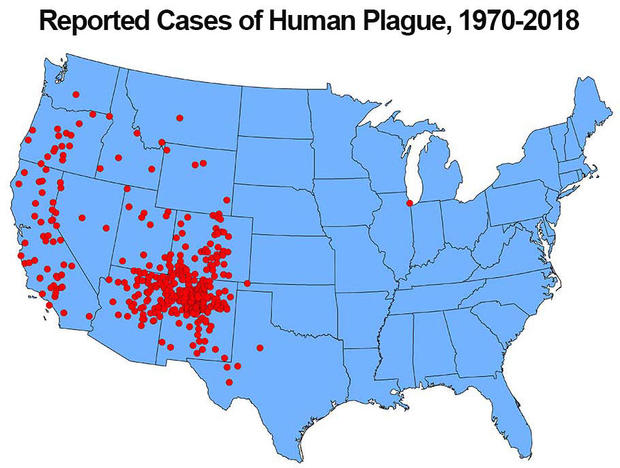 Dr. Robyn R.M. Gershon, a professor and program director at the NYU School of Global Public Health, told CBS News on Wednesday that only people who live in an area where the disease is common need to be concerned. "With proper precautions, you can avoid contact with possibly infected fleas," Gershon said. "If you do get infected, there is very good treatment available with antibiotics. The only risk is that the infection will not be diagnosed promptly, which can then lead to more serious disease." There have been five cases in the U.S. so far this year. A significantly higher portion of cases are reported in parts of Africa and Asia, but it can be found on all continents except Oceania. How is plague treated?"Infections in humans are rare," Dr. Gershon said. "Most recover, although occasionally there is a death related to some of the more severe forms the disease can take." Early diagnosis and treatment are essential for survival and reducing future complications. Common antibiotics, such as streptomycin, can prevent complications or in some cases death, if administered soon after symptoms present themselves. Untreated bubonic or septicemic plague can develop in the pneumonic plague, which spreads to the lungs. The bubonic type has a case-fatality ratio of 30% to 60%, according to the WHO. Pneumonic plague, when left untreated, is always fatal within 18 to 24 hours. "The key for clinicians is suspecting plague in the first place, obtaining the right specimens to make a diagnosis, and initiating treatment even before the diagnosis is made — as soon as you suspect it, you should start treating while the evaluation is ongoing," Shenoy said. There is not currently a vaccine for the plague available in the U.S., but researchers are investigating several options to try to eradicate it. No vaccines are expected to be commercially available in the near future. How can I protect myself from the plague?"It's important that individuals take precautions for themselves and their pets when outdoors, especially while walking, hiking and/or camping in areas where wild rodents are present," California's El Dorado County Public Health Officer Dr. Nancy Williams said this week. "Human cases of plague are extremely rare but can be very serious." Low levels of the bacterium persist in certain rodent communities without causing a significant die-off, making the disease difficult to fully eradicate. Eliminating rodents is a key prevention method. Removing nesting places — brush, rock, trash, firewood and possible food supplies — around homes and workplaces will help. If you come across a sick or dead animal, do not touch it yourself, especially without gloves. Contact your local health department regarding disposal. Using insect repellent that contains DEET could prevent flea bites while camping, hiking, or during other outdoor activities. It is also important to treat dogs and cats for fleas on a regular basis, and the CDC advises not sleeping in the same bed with pets that roam free in endemic areas.  |
| You are subscribed to email updates from "how is plague transmitted" - Google News. To stop receiving these emails, you may unsubscribe now. | Email delivery powered by Google |
| Google, 1600 Amphitheatre Parkway, Mountain View, CA 94043, United States | |


Comments
Post a Comment