Medical Conditions That Can Keep You from Joining the Military

Invalid Access Key! Invalid Access Key!
“31 dead in DR Congo plague outbreak - Medical Xpress” plus 2 more |
| 31 dead in DR Congo plague outbreak - Medical Xpress Posted: 19 Feb 2021 05:39 AM PST  Thirty-one people have died in an outbreak of plague that erupted in northeastern DR Congo three months ago, health officials and experts said on Friday. "We have more than 520 cases... of which more than 31 have been fatal," Patrick Karamura, health minister in Ituri province, where plague is endemic, told AFP. The cases are the bubonic form of the disease, except for five cases of pneumonic plague and two of septicaemic plague, he said. Anne Laudisoit, an epidemiologist with a New York-based NGO called Ecohealth Alliance, said the cases had surfaced between November 15 and December 13 in Biringi, in Ituri's Aru Territory. The average age of patients was 13, but this varied between three months and 73 years, she said. The World Health Organization (WHO) issued an alert in July of a plague outbreak in Rethy, also in Ituri. Plague has persisted in the province since it was first confirmed there in 1926. A long-feared disease with biblical connotations, but treatable today with antibiotics, the plague is caused by a bacterium called Yersinia pestis. Laudisoit, who is in the area with a team of researchers, said an early sign of the latest outbreak came with the mass death of rats. Germ-carrying fleas which live in the rats' fur then look for other hosts in proximity, which are humans. The bacterium is then transmitted through flea bites. The east of the Democratic Republic of Congo also struggles with episodic outbreaks of Ebola. Healthcare has been badly hit by militia groups that teem in the region. Explore further © 2021 AFP Citation: 31 dead in DR Congo plague outbreak (2021, February 19) retrieved 19 February 2021 from https://medicalxpress.com/news/2021-02-dead-dr-congo-plague-outbreak.html This document is subject to copyright. Apart from any fair dealing for the purpose of private study or research, no part may be reproduced without the written permission. The content is provided for information purposes only.  |
| Using Plague Diaries to Keep a Record of COVID-19 - UC San Diego Health - UC San Diego Health Posted: 18 Feb 2021 07:11 AM PST Humanities courses in history, philosophy and literature bring discussion of today's pandemic into the classroom, offering students a unique way of learning The first entry in Paige Nguyen's pandemic diary shows a quiet campus. Photo courtesy of Paige Nguyen. The first photo in Paige Nguyen's pandemic diary is full of complexities. The UC San Diego student's eyes gaze back at the camera, her smile hidden by a mask and the iconic Geisel Library stands behind her without a soul in sight. But there's hope in her work, too. As a first-year student, Nguyen has yet to experience a full campus teeming with activity, but one assignment in her History of Public Health class— the term project "Diaries in the time of Plague"—brought this moment into sharp focus. "Studying epidemics of the past is already an interesting topic, but even more so when you're living through a current pandemic," Nguyen, an education studies major, said. Her "plague diary" now rests in the UC San Diego Library's Special Collections & Archives. "We learned a lot about looking back at the past [to] see what worked and what didn't work, but diseases are more than just a virus or bacteria—they also have a lot to do with social and political conditions," she said. Department of History associate professor Claire Edington, who is developing a book with University of California Press based on lessons from the course, has been teaching the history of public health for five years, and each year a new pandemic emerges: the most recent Ebola outbreak, the opioid epidemic and, this year, COVID-19.  Paige Nguyen uses this photo of herself in a grocery store to comment on mask wearing and responsibility. Photo courtesy Paige Nguyen. "The history of medicine has always served as an important window on social history, and looking at pandemics in general shows how epidemics have the potential both to reflect and remake our social world," Edington said. "For instance, the recurrence of certain themes in the history of pandemics—the scapegoating of minority groups, or grassroots anti-vaccination movements—works powerfully to disrupt any linear narrative of progress. How do we mobilize the insights of history to create a more just, equitable world moving forward?" Edington said the class explores the global history of epidemics in their unique historical context, and takes care to not centralize a European or United States perspective. The first use of gauze masks, for example, was in Manchuria during the pneumonic plague of 1910-1911, she said, and not the Spanish flu pandemic of 1918. "Instead of looking for clear beginnings and endings, we look at how epidemics layer onto each other. They are not just discrete events," she said. "The students really appreciate having this historical perspective, and it felt particularly poignant to be teaching this class now." Using the diaries as a way to process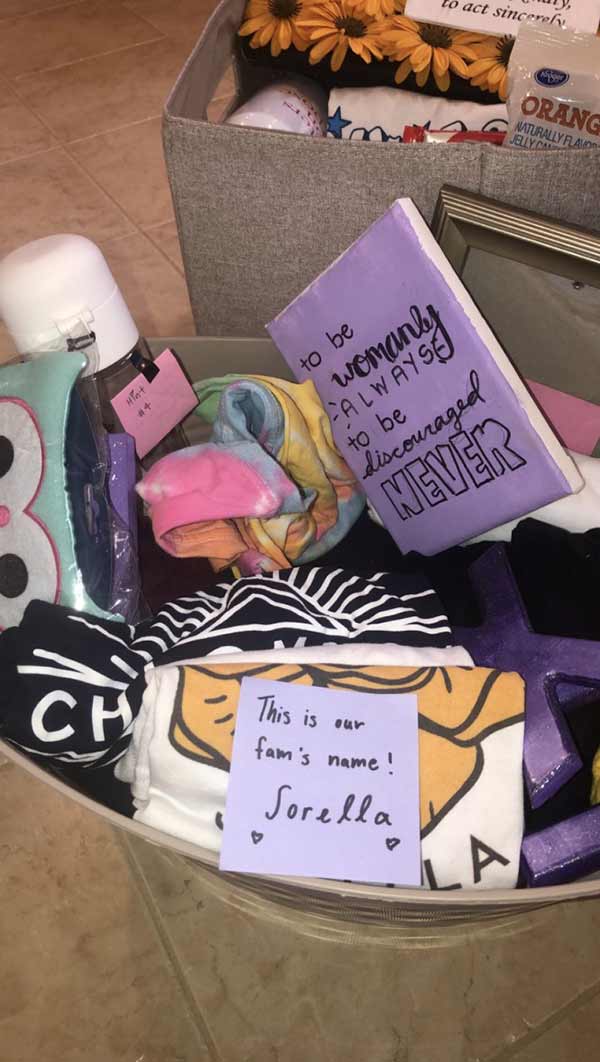 Paige Nguyen is part of the Chi Omega sorority, and her Nov. 13, 2020 entry explains how they adapted in-person traditions like gift giving to the pandemic. Photo courtesy of Paige Nguyen. Just one portion of the class, students are not required to submit their diaries to the UC San Diego Library, and if they do, they can submit anonymously because much of the content is deeply personal. Edington said she wanted to give space for the class to be more reflective, as she's aware this is a difficult time to be a student. She said she was surprised by how candid some of the submissions were, and was glad the students were able to open up. "My biggest takeaway from this assignment was the importance of letting out emotions during this hard time," said Anushka Sinha, a third-year biology student. Sinha said the assignment became an outlet, and voiced frustration about what the pandemic has taken away from their college experiences. "There has been so much more focus on spreading hope and optimism during this pandemic, that somewhere we forgot to acknowledge our present feelings or our current state of mind," Sinha said, a feeling reiterated by Morgan Korovec, a first-year student majoring in communication. "Completing the diary assignment encouraged me to make time for self-reflection and to really think about the important things, even beyond the scope of college life," Korovec said. "I realized it's not possible to understand what everyone is going through, so it is especially important to practice kindness and to build strength together as a community." In preparation, the students read and reflect on first-person accounts from past pandemics, starting with the Athenian plague of 430 B.C.E. followed by the Black Plague of the mid-1300s and, lastly, a personal journal from Wuhan, China near the start of the COVID-19 pandemic. Entries could be in whatever format the students wanted: written, photographs with captions, drawings and art, and video diaries.  This photo of empty shelves accompanies an anonymous diary entry: "For some people, donating and helping others brings them comfort. While for others, excessively hoarding items and piling 6 cases of toilet paper in their carts seems to bring that same feeling of fulfillment." "I noticed when Dr. Edington had us read plague diaries from the past, what makes these different from other primary historical sources is they're much more personal. I wanted to emphasize that in my own diaries," said Clara Pham, a first-year history major. Her diary entries were audio recordings, so she could capture more intimate moments of silence and sound. "I thought it was more personal, and I wanted my audience to get another layer of vulnerability," she said. Recognizing the underlying connection to raceEdington's fall quarter course is one of three featured humanities-based classes that adapted their syllabus to speak to today's pandemic. In summer 2020, associate professor Saba Bazargan-Forward developed his Department of Philosophy class Ethics & Society to explicitly address issues pertaining to COVID-19, including moral discussion around face masks and forced quarantine, racism and disproportionate COVID-19 deaths, and privacy regarding contract tracing.  From an anonymous diary: "This house is not just a Halloween set up. Back in June, I stumbled across it. The yard is set up as a graveyard, warning people to keep practicing proper social distancing." In the Department of Literature, assistant professor Erin Suzuki is currently offering Pandemic Fictions, looking at representations of pandemics in modern American fiction to highlight understandings of public health, race and economics. The intention is to "imagine ways to improve or push beyond these systems and structures," the 2021 winter-quarter syllabus reads. "The discussions are grounded in the narrative structure of pandemic literatures, as a way to get students to think about how much they have been conditioned to conceptualize outbreaks," Suzuki said. "We're conditioned to think of pandemics as having a beginning, middle and end, but they are clearly ongoing. So far, the class has been good for discussions because there is always something for them to compare these narratives to." Suzuki, whose research interests include Asian American literature and Pacific Island literatures, explained that in the texts for the class, pandemics are metaphors for something else—oppressive governments, racial inequalities—but for students today, "pandemic" is more than a metaphor. It is literal, and Suzuki encourages students to discover similarities in what they read and what they see. 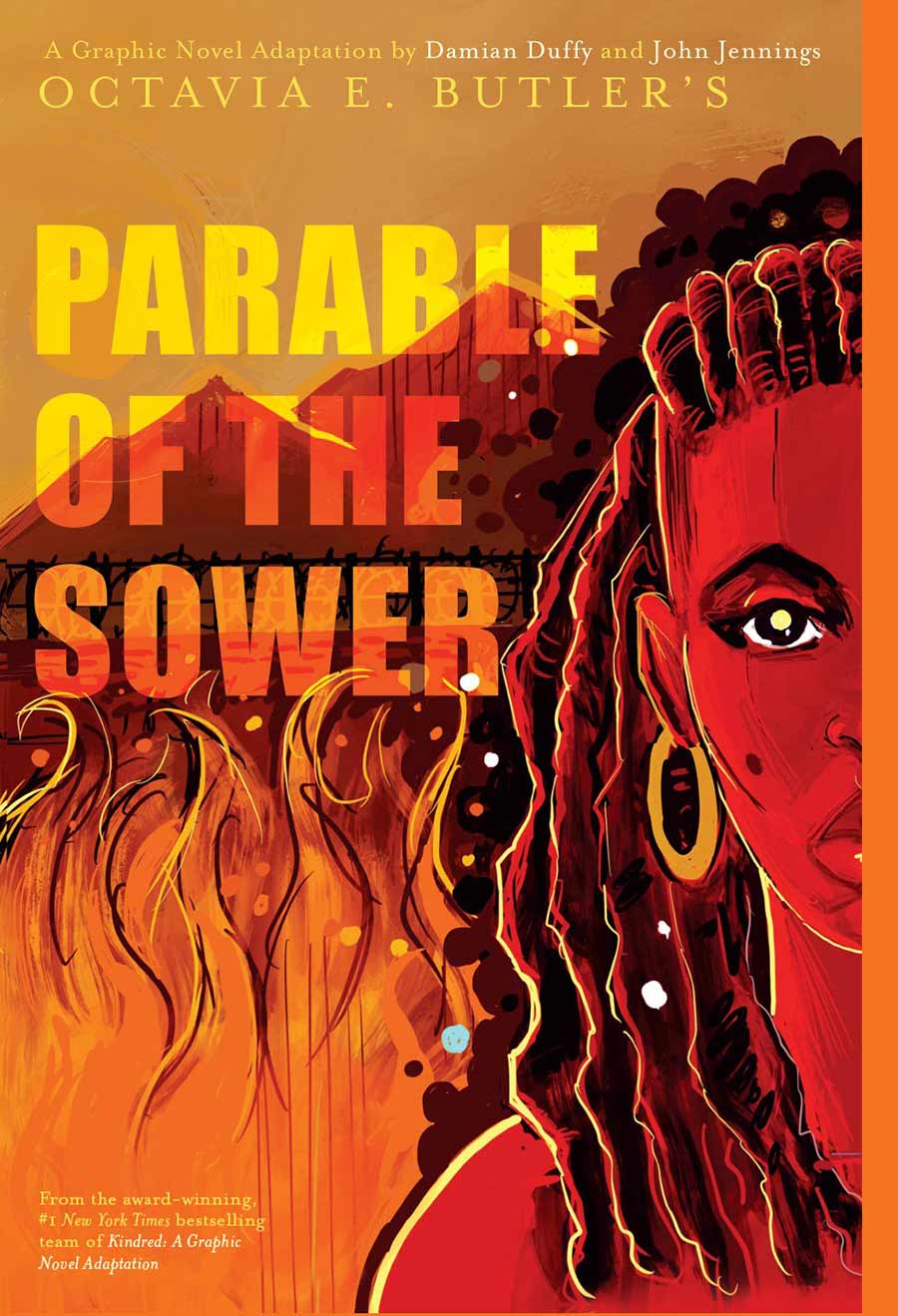 Octavia E. Butler's "Parable of the Sower," a graphic novel adaptation by Damian Duffy and John Jennings (Abrams ComicArts, 2020), is used in the Pandemic Fictions course. "The COVID pandemic and the way it is manifesting reveals all of these fault lines around race in our society," she said. "Race is always sort of a subtext to the pandemic in these narratives, and a lot of the students bring that up in the class." As literature, ancient and new philosophy, and historical record can provide nuance and perspective for multiple generations, the Library will make available the students' pandemic diaries for future use. The students who have submitted to the archives are ensuring their stories are told, and Pham said she wants people to understand how today's situation has influenced ordinary people, day to day. "Our campus is a global campus, and I really do feel our curriculum should reflect the experiences of our students and give them a place to talk about their own stories," Edington said. "The act of the diaries itself was like giving back to our community. It is an act of service."  |
| Emaciated man and wife carved in stone recall gruesome plague - Belfast Newsletter Posted: 19 Feb 2021 01:00 AM PST  You know the kind of thing - a tale from days of yore that's common knowledge, or it should be, but it has passed you by. Story-teller and author Doreen McBride's quirky but authoritative local-history books have often featured on this page and her latest publication, about Banbridge, will get an airing here soon. But a recent email from Doreen was about some very striking sculpted stone memorials in Ireland which I'd never previously known about or visited. Formerly a biology teacher at Wallace and Dromore High schools, Doreen lives in Banbridge but regularly navigates Ireland's highways and byways in search of local history and mythology for her books. Before describing the intriguing tombstones in St. Peter's Anglican Church in Drogheda, Doreen put our Covid-19 pandemic into its historical context, long before the tragic, post-WWI global influenza. "The more I think about it," she explained "the more I feel grateful not to be living in the dark ages when Europe's population was decimated by bubonic plague, also called the Black Death." Back then "there was no scientific knowledge to fall back on, no treatment and no means to stop it spreading," her e-mail continued, "so it must have been even worse than our present nightmare!" Please don't read Doreen's description of the symptoms of the Black Death if you're about to have a meal, or are wanting a good night's sleep any time soon. "Bubonic plague causes the body's lymph glands to swell forming painful buboes (large, inflamed lumps). "Parts of the extremities, such as the tips of noses, fingers and toes may become gangrenous and the patient develops a high fever and may vomit blood continuously. When it gets into lungs it becomes the highly contagious pneumonic plague which can pass through the air from human to human." Doreen's email continued with some more extremely unnerving aspects of the Black Death before recounting the sad story behind Drogheda's two poignant tombstones. She referred to the old saying 'Eat, drink and be merry for tomorrow we die' which "hides a dark secret", Doreen explained, adding "people could catch bubonic plague and die very quickly, so they thought 'Life is very fragile. We could die within a few days. We 'might as well enjoy ourselves while we can' so they sang, danced and generally acted the 'lig'!" She wondered in her email "if that's a reason behind some of the behaviour people are displaying today, when they go to parties and meet with people against scientific advice?" The Black Death killed over 30% of Ireland's population in the mid-14th century "and the cadaver tombs on the boundary wall of St. Peter's Anglican Church, in Drogheda are a reminder of that terrible time," explained Doreen, describing the tombstones as "gigantic, rare structures intended to depict the fragility of life. The ones in St. Peter's churchyard are on the east wall behind the present church. They are gruesome!" For the uninitiated, a cadaver monument (or memento mori monument, Latin for 'reminder of death') is a type of churchyard tombstone commemorating the dead with a sculpted effigy of a skeleton or an emaciated, even decomposed, dead body. Cadaver stones were particularly characteristic of the late-Middle Ages and were designed to remind passers-by of the transience and vanity of mortal life and of the desirability of the Christian, eternal, after-life. Cadaver monuments, with their intricate and often complicated sculptural details, were generally reserved for high-ranking people, like royalty, bishops, abbots or nobility. Those whom they commemorated needed to be wealthy to afford one to be made, and influential enough to be allotted a space for one in a churchyard of limited capacity. The dead people represented on the carved stones weren't necessarily entombed or buried underneath, or even in the same graveyard. Today's page ends with Doreen's description and history of the stones in St. Peter's in Drogheda. "There's one for a man and another for a women. They once covered the bodies of Edward Goldying (sometimes spelt Golding) and his wife Elizabeth Fleming, who died from the Black Death sometime between 1348 and 1350. "They are sculptures of partially decayed bodies, partly covered by shrouds. "Originally they would have been in a horizontal rather than a vertical position and nobody knows who moved them and placed them on the graveyard wall, or why that was done. "The larger tombstones stretch from the base of the wall to the top and the bodies are anatomically all wrong! They have about 61 pairs of ribs each and the woman has a large internal space thought to be needed to accommodate a growing baby!" Elizabeth Fleming died from the bubonic plague before her husband. "Edward appears to have recovered quickly from his loss because he had three more wives before contracting a fatal dose of plague himself. The extraordinary thing is that Edward Goldying died three months after his first wife! "Smaller memorials commemorating his other three wives are to be found beside the larger cadaver tombstones. They are a grim memorial of a frightening period of history although there are those who would say they serve as a warning - having three wives in three months is enough to kill any man!"  |
| You are subscribed to email updates from "pneumonic plague" - Google News. To stop receiving these emails, you may unsubscribe now. | Email delivery powered by Google |
| Google, 1600 Amphitheatre Parkway, Mountain View, CA 94043, United States | |


Comments
Post a Comment